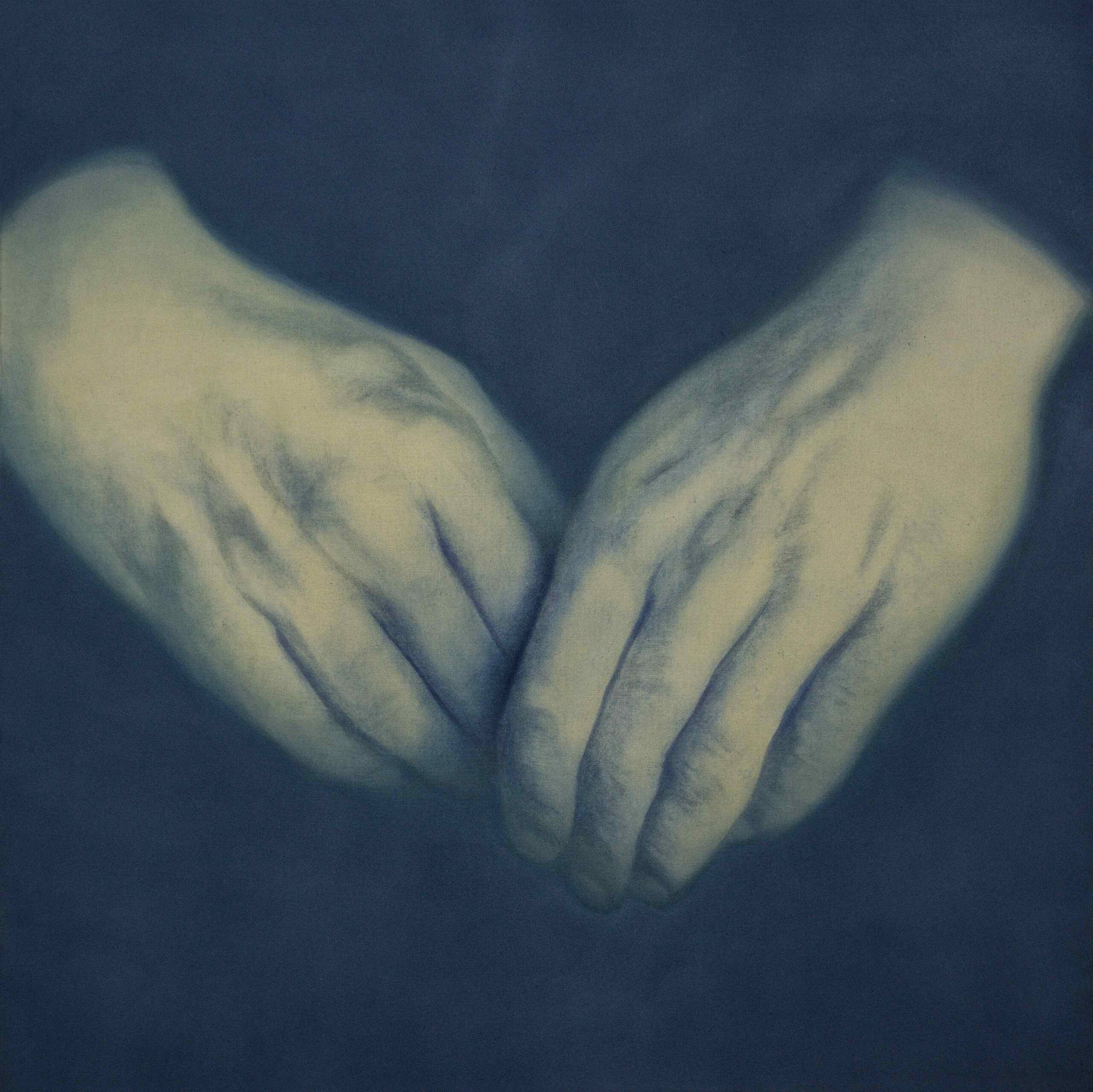
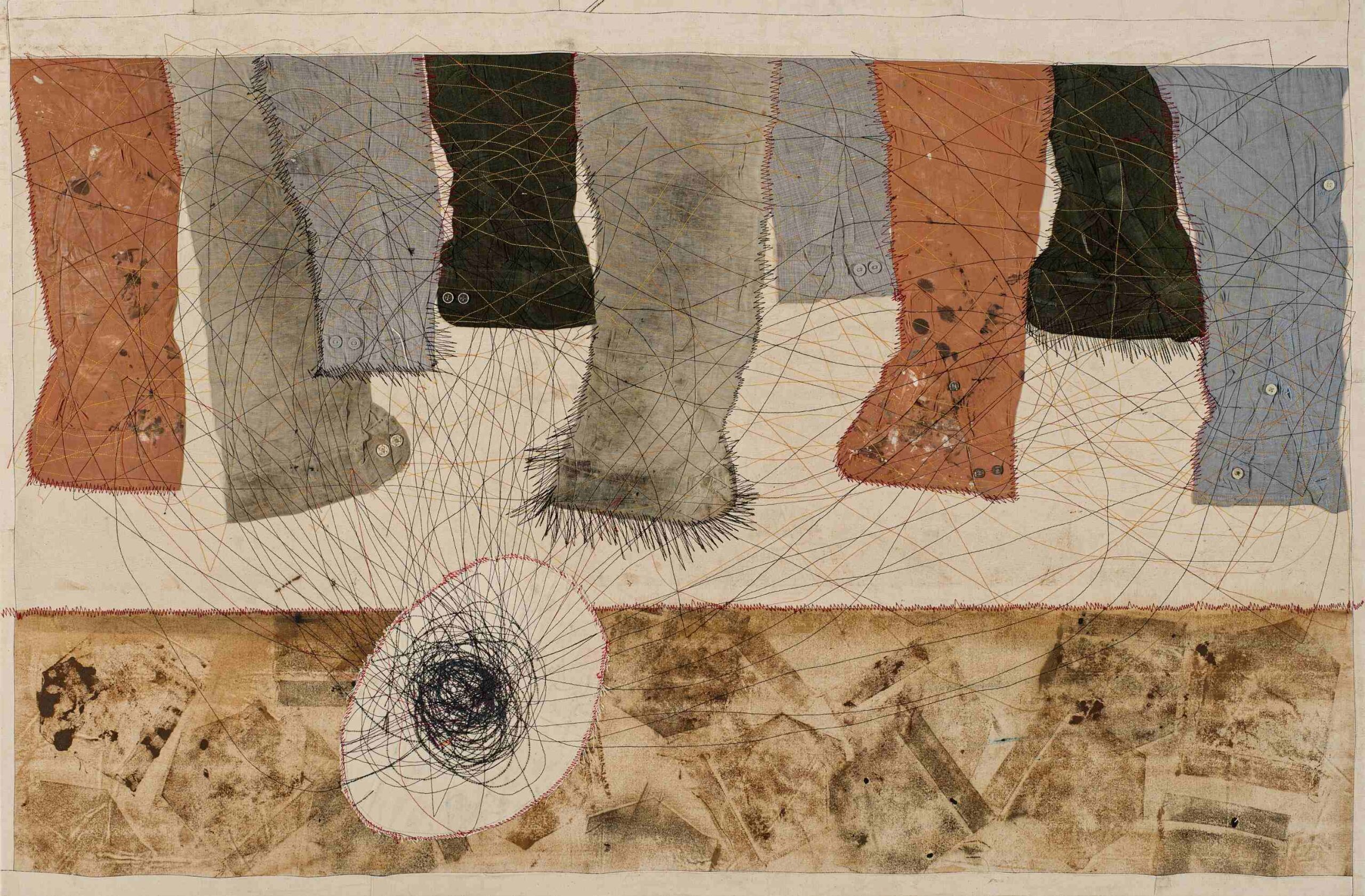
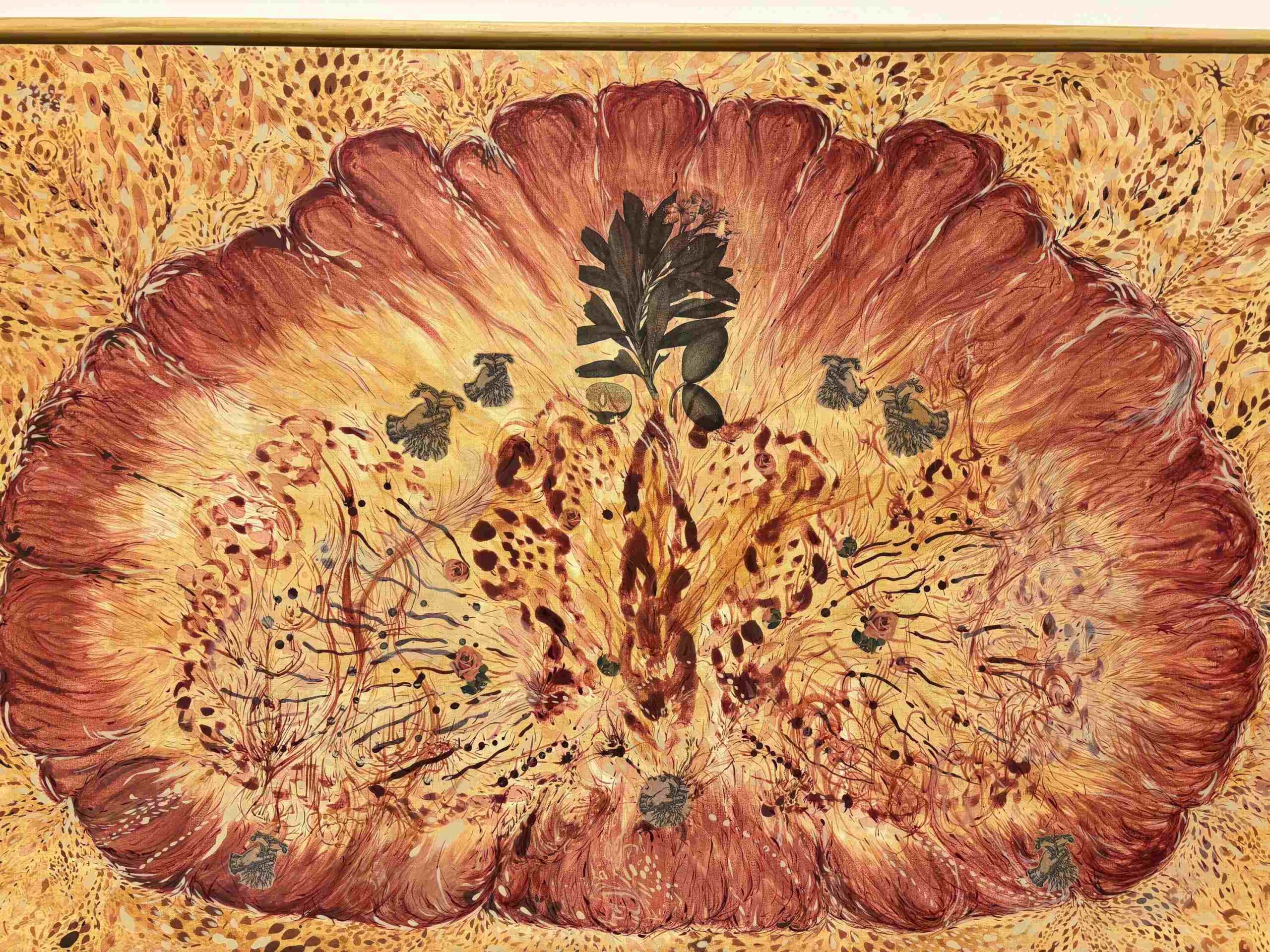
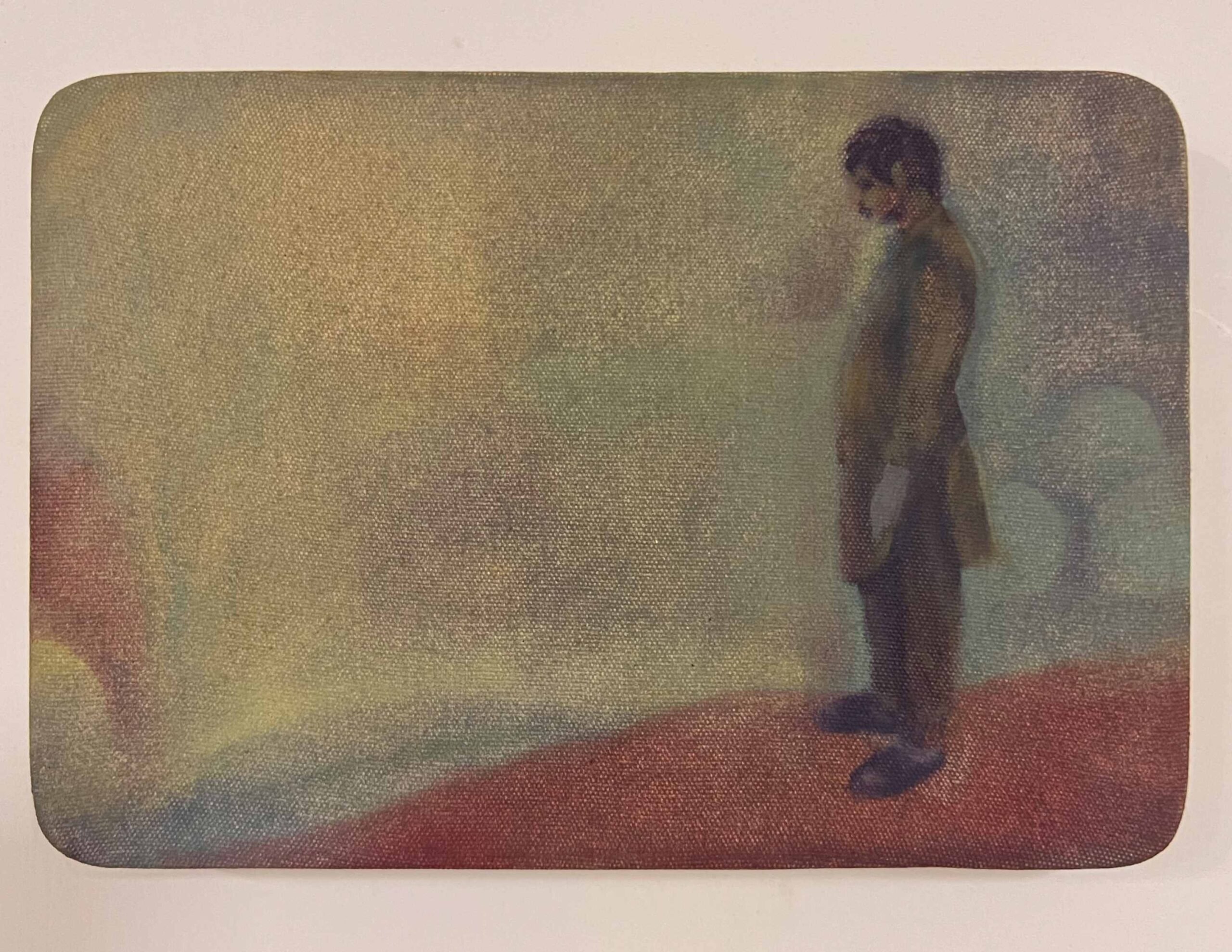
You can’t quite hold onto this image. You recognize it, but it keeps dissolving as you look at it. You try to identify it. You move closer. You step back. You look for its edges. You search for colour, its shape, its weight, some clue to what it is. It dissolves. It is an aarti diya. Something in you settles, then unsettles. The aarti diya belongs to a Hindu ritual, but here it belongs to a childhood. A childhood where Hindus and Muslims co-exist. It belongs to home, to celebrations and friendships, and to Kanchan Maasi, the closest friend of Ahsan Memon’s mother in whose house he spent much of his early life. You are not given the memory. You are given its trace. So, you look again. A face held between hands. Palms pressed over ears. A head resting its weight on one hand, so that the hand is both body and ground. A man with a chadar over his head, eyes half open, suspended between looking and withdrawal. These gestures are quiet but they are not passive. They turn the body inward. Eyes close and the exchange of looking ends. Ears are covered and the world is cut off. Attention shifts from what surrounds the figure, to what is happening within it. Weight. Pressure. Enclosure. The body is at once touching and being touched, seeing and being seen, and these paintings hold this doubling in place. The hand that touches the face is also the hand that the face feels. You are not shown a person having an emotion. You are placed inside a bodily condition; weight, pressure, enclosure. The eyes do not make contact with you, so you look at the hands. You see a hand on the heart. You think of a vow, a wound, a sign of respect or a pulse. Then two hands entwined. The light moves through them and the detail goes. Fingers lose their edges. Knuckles become glow. You try to work out which hand is which, whose fingers are over whose, and the image will not sort them. You stop looking and start feeling your way across it. Then two hands hold something. Or they place it somewhere. You can’t tell whether the gesture is taking or letting go, and the object has already dissolved. What is left is the shape around an absence. Nothing arrives complete. Everything is passing between states. The paint insists on it. The palette is restrained, and the surface is blurred. The body appears and disappears in the same gesture. It is dispersed across a gesture, a friendship, a room remembered from childhood. The object carries one history; the hands and faces carry another. Together they make an assemblage, of what has been encountered, held, withdrawn from and carried forward. Look at the hands again. They hold, or they place. They cannot decide. A palm stays pressed to a face long after there is any reason to. Perhaps this is the weight of the paintings. An image the body would set down if it could, but cannot. This is also why you cannot hold onto it. The paintings do not offer memory as a picture. They offer fragments: a blurred face, a hand, a closed eye, a familiar object. Each is on the verge of vanishing or appearing. The figures cannot release what they carry, and you cannot keep what you see. Between these two failures, something stays. A wash of grey. A glow. A breath of blue. None of it is heavy, yet all of it weighs. You do not leave with an image. You leave with the burden of it.