The story goes, though not fully accurate, of an encounter between Henry Moore and a village gardener. The humble farmer asks his esteemed neighbour, who was working on large pieces of sculptures. ‘Mr Moore, why are you making these things, what is the use of them?’. The British sculptor’s reply was also a question, ‘Sir, you grow crops and vegetables in your field, but you also plant flowers; could you please tell me about their purpose?’
As human beings, we are obsessed with useless acts, objects, and productions. We read novels, watch movies, listen to music, love gossip, walk aimlessly, or sit idly. Absorbed in such activities and engaged with articles that may not have any meaning, significance, and usage, but provide us great pleasure. However these purposeless pursuits, in reality, also satiate some deeper needs in a mortal who is conscious of the brief duration of an ordinary life in this centuries old cycle of existence. As he/she is surrounded by elements which seem timeless; a reflection, manifestation or attribution of God. Mankind’s stay on this earth is temporary, but through recognizing and establishing a connection with entities, which contain no apparent utility (but are being reincarnated in one or another form), a human being identifies with Divine. Looking at a hibiscus, a petunia, a peony, a sunflower, a lavender, a hyacinth, a lily; one is amazed on the perpetual presence of the Supreme, in every work He created with intricate, complex, and pretty substances bearing tiny streaks, shades, surfaces, veins, and innumerable delicate features.
Flowers, besides being a form of delight, part of diet, or ingredient of conventional medicine, suffice as a source to extract artists’ pigments. The three-way affair of humans, plants and paint, is now much known, and has proliferated in multiple schemes, recipes, and variations across regions and histories. Each culture appropriating, translating and transforming others’ discoveries, experiments, and advancements in their specific systems, has enriched the common knowledge we all inherit today. Yet despite the differences in research, resources environments, tastes, tools, and ways of seeing the world, flowers are collectively considered and treated as being a symbol of beauty, purity, joy, and spirituality. An entity, dysfunctional, but offers immense satisfactions to the eyes, thus to the soul.
This aspect of flower led to shaping a range of pots, vessels, jars, vases – in glass, crystal, terracotta (raw or glazed), tin, aluminium, copper, silver, gold, and precious stones – of all imaginable dimensions and shapes. To meet the requirement to carry flowers in hands, to hold them in arms, take them to a party, place them in the middle of a room, and for decorating a marriage hall, or some other banquet.
Actually it’s the context that alters the content connected with flowers. If put as a wreath on the monument of a national hero or a war martyr; a garland adorning the statue of a freedom fighter; as bangles around the wrists of a young woman; in strings spread on a parent’s grave; a single fresh one held in the hand of a lover; the symbol of a commercial product; a political party’s electoral sign; each of these contexts convey varying scenarios and demand different reactions.
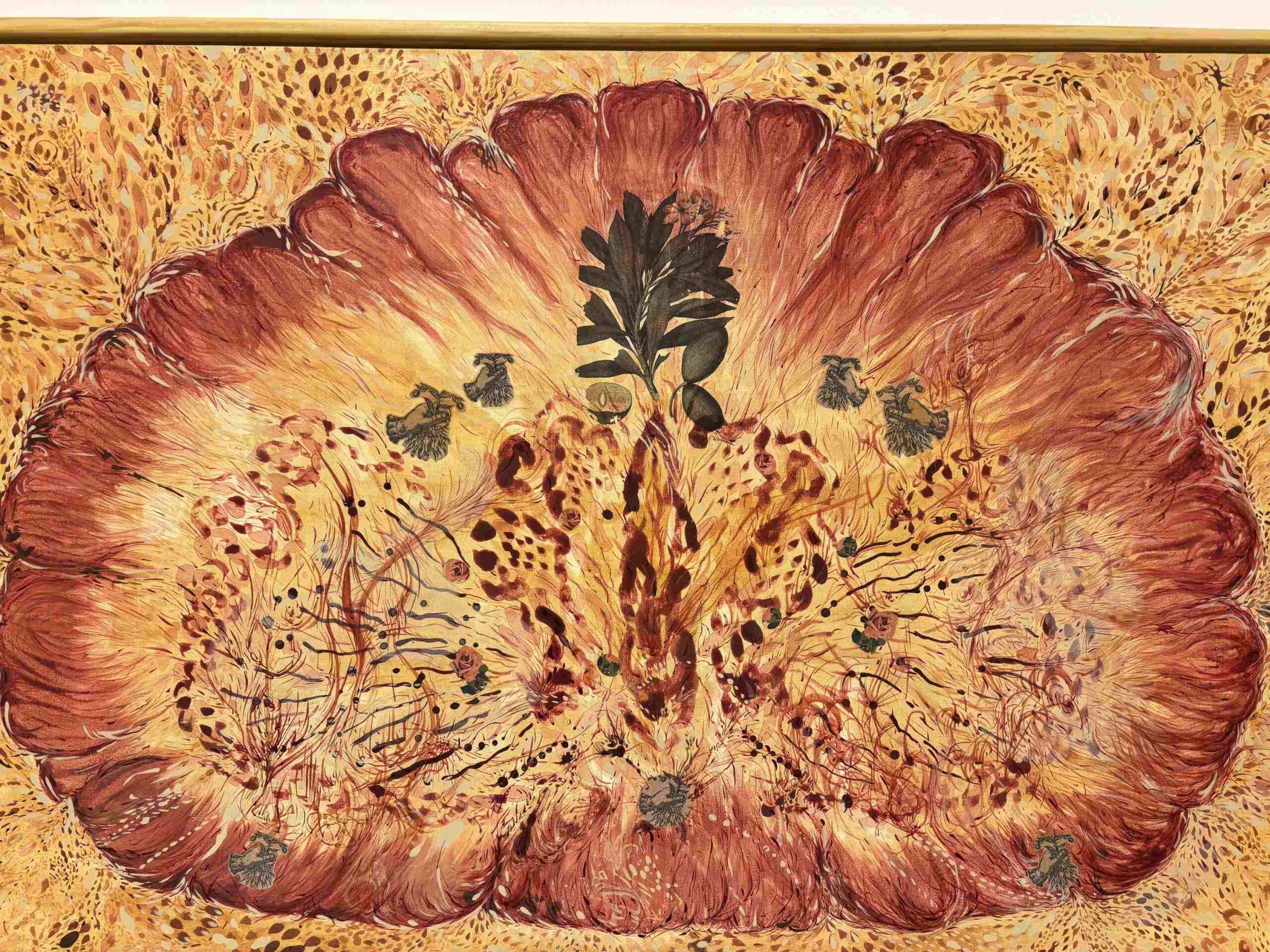
In Fatima Zaman’s work, flowers seem like a household entity. Not only in a literal sense, but in their wider understanding. She intricately paints flowers, either lonely, bouquets, or arrangements, but each of these possesses a central position/role in her compositions. Her delicately rendered flowers – usually applying natural pigments, along with regular art material on hand made papers and canvases – appear like
portraits of the species. Although not a botanist’s diagram, or a tourist’s documentation; but an artist’s act of seeing these flowers as independent characters, more like any familiar being. Which, if one is a gardener, or spends time in nature, knows and identifies with. Because the shape, state, condition, and liveliness of each plant is unmatchable. Much like every human being, who is a unique soul. Thus it is hardly surprising that people who admire vegetation and are constantly attached to them, often talk to their plants as if speaking to their fellow human beings.
Muslim artists, manuscript and miniature painters, understood the concept of soul in the entities created by God; because for them the entire universe was part of the Divine, thus there is nothing that is devoid of a soul, so each part of nature is endowed with a soul, a distinct identity, and an independent place in the complex system of visible, metaphysical, multiple, and parallel worlds.
Likewise flowers turn immortal in the hands of Fatima Zaman. Tiger Lily, Pink Hibiscus, Kalgi, Gulchean, Peach Flower, Hydrangea, White Orchid, and a few others – separate or in group – look as if breathing, happy, satiated, and well settled in their environment. The surrounding of these flowers, in an intriguing way, is not natural, but domestic, rather designed, curated, and urban. Inserted in metallic jars, spread in the middle of porcelain bowls, placed in utensils of various shapes, these flowers offer a state that refers to the comfort of a person, as well as to the world of the artist’s own making. Zaman’s skill in delineating her subject is remarkable, as she excels in her pictorial vocabulary regardless of change in material, technique, medium, size. Some of her paintings include gold leaf as border, or silver leaf as the component of an object. All these pictorial devices help Fatima Zaman’s work to reach the window of our eyes, and to stay in the garden of our souls.
Emanating from all of her paintings, these stems with petals and leaves – borrowing a phrase of T. S. Eliot, “had the look of flowers that are looked at”.