One can speculate about the population of Pakistan; whether 250 million, or more, or less; but one is certain that locks in the Islamic Republic are much more compared to the number of its citizens. Probably 10 times, if not more. Usually when a person shifts to a new place, the first thing bought is a lock to replace the previous one. This task is performed without hesitation, deliberation, or pause. Not only is safety of the outer door crucial and urgent, but every room of a house, office, and other property is padlocked. Security locks are put on cabinets, drawers, travel bags, refrigerators, jewelry boxes, vehicles, computers, bank vaults, prison gates, metal safes, market entrances, shop shutters, etc.
These locks are available in numerous designs, sizes, and versions. From old-fashion heavy iron ones to latest slim products, from touch-sensitive gadgets to inconspicuous models, or those operated with codes and numbers. If one takes a break and ponders on the nature of this item, on the reasons behind its invention, presence and perpetuation; it is concluded that the existence of a lock, more than anything else announces the existence of a potential thief. It indicates lack of trust, insecurity, and threat. In 2018, I had a unique experience of not bolting my room, locking my suitcases, hiding my valuable belongings, concealing my wallet; while staying in an artists’ residency programme at the Pioneer Cement Factory Khushab. All participants were dealing with a (new) life without locks, which felt a bit scary, odd, and impossible, but at the end every artist must have looked at locks being an unnecessary item.
Probably not different from our ancient ancestors’ reaction when someone introduced the notion and devised the primitive form of a lock. But today we got so used to this product that no residence – all over the world – is devoid of this device. It is an essential, familiar and compulsory article of our life. From its basic beginning and crude origin, it has evolved to fancy and beautiful artefacts. Some even adorn our anthropological and art museums around the globe.
We have a similar situation with safety walls, barricades, barriers, fences, barbed wires, metal detectors, and scanning machines in this time and day. Before 9/11 passengers on domestic flights were not stopped for their identification, body search, and luggage scrutiny. If travelling light, they carried their cabin bags to the plane without hurdle or scrutiny. Now, before leaving your house, you mentally begin preparing for a long chain of checks, thus dressing and packing accordingly. So conditioned that we do not wait for the security personnel’s command, and start operating in the required sequence. Likewise a residential place, an office block, a business venture, a housing society, a hospital, an educational institution, a shopping mall, a cinema hall, a shrine, a place of prayer, especially in cities, cannot be conceived without a huge paraphernalia of security contraptions.
We have grown so comfortable with these barriers and blocks that we cease to register their strange presence amid us. Reminding a passage from One Hundred Years of Solitude, in which Gabriel Garcia Marquez describes the epidemic of amnesia in Macondo. In their fight against the loss of memory, the inhabitants of the town “with an inked brush marked everything with its name: table, chair, dock, door, wall, bed, pan.”1; going further they labelled animal and plants, like the sign that hung on the neck of the cow read: “This is the cow. She must be milked every morning so that she will produce milk”2, and so forth. Till Melquiades the gypsy traveller, cured them and people realized their folly.
Today the citizens of every contemporary city are living in the imaginary settlement of Macondo, sharing a similar kind of ignorance. The habit of witnessing security objects, machinery, arrangements made us oblivious to their strangeness, let alone the pain they cause. On the other hand these are perceived as integral commodities, and demanded by visitors if they fail to spot/go through these. In our culture these safety machines end up as desired goods; and with the passage of time we have learnt including them inside and outside of our premises.
Seema Nusrat recognizes this transmutation in human behavior as well as physical objects and environment when it comes to the question of self-security. While living in Karachi, she mapped the measures of safeguarding a private space, an official complex, a religious building, an educational institution, a public park, an urban market, etc. Which if on the one hand resist a terrorist attack, also invade the vision of a citizen; and erect physical, optical, and psychological barriers between an outsider and a sanctuary. With the increase in extremist threats, political protests, indiscriminate criminals, the presence of these hurdles is considered natural. Yet the feeling of unease on crossing these barriers and the knowledge of their indispensability invoke a conflict. The coexistence of trouble and protection in the context of these objects is addressed by artists in diverse ways. By presenting them without a background, hence drawing our sole attention towards these blotting products (Bani Abidi); looking at these eyesores through the lens/aesthetics of Minimalism (Seher Naveed); extracting a delicate/amorous content from the harshness of these hostile inventions (Farida Batool).
All these artists expose the contraptions of security being the illusions. The more a threat increases, the higher an external wall is, the stronger a building’s facade, sand sacks grow, fences thicken, iron bars multiply, yet perpetrators find their passage to reach the tightly guarded sanctum. Thus the artists present these pictorial objects as delightful to view but disappointing to fulfil the purpose. Seema Nusrat expands this approach in her practice. In her artwork, the material, technique, scale, visual components, their composition and treatment enhance the reality of security apparatuses’ decorativeness, more than their functional side.
Thus the outer walls, metal gates, iron bars, concrete grills, traffic police separators, camouflaged structures, watch towers, green dividers, organic fences appear as detachable components of building; actually the building in Nusrat’s work; because in every image, there is nothing except these protective layers. In her immaculately fabricated art pieces, parts and kinds of diverse safety devices are composed like pieces of Lego. A feeling multiplies by the chromatic scheme, flatness, and geometric division in each work. An important segment of their making is the artist’s choice of material and technique. Nusrat has picked acrylic sheets, and joined them in a mechanical manner. Thus the work becomes more and more a substitute of actual items than their representations. Just the fact that we cannot detect the touch of a human hand supports the understanding of these objects being non personal, industrial, neutral, practical products. Like prefabricated and familiar items we collect for use or decoration.
Since Seema Nusrat moved from Karachi to Lahore, one deciphers a shift in her aesthetics. Nusrat observed the abundance of green safety net (made of industrial material) stretched on balconies, terraces, entrance spaces, out of windows to ward off the harsh sun of Lahore – to protect the plants, and providing shade and privacy to the family. Traditionally produced as loose lengths of fabric, now these are made – fit to size – in fiberglass sheets to keep sunlight, rain, insects and birds away. The cover’s color compliments the greenery from the surroundings, hence giving the illusion (and satisfaction) of being an organic substance.
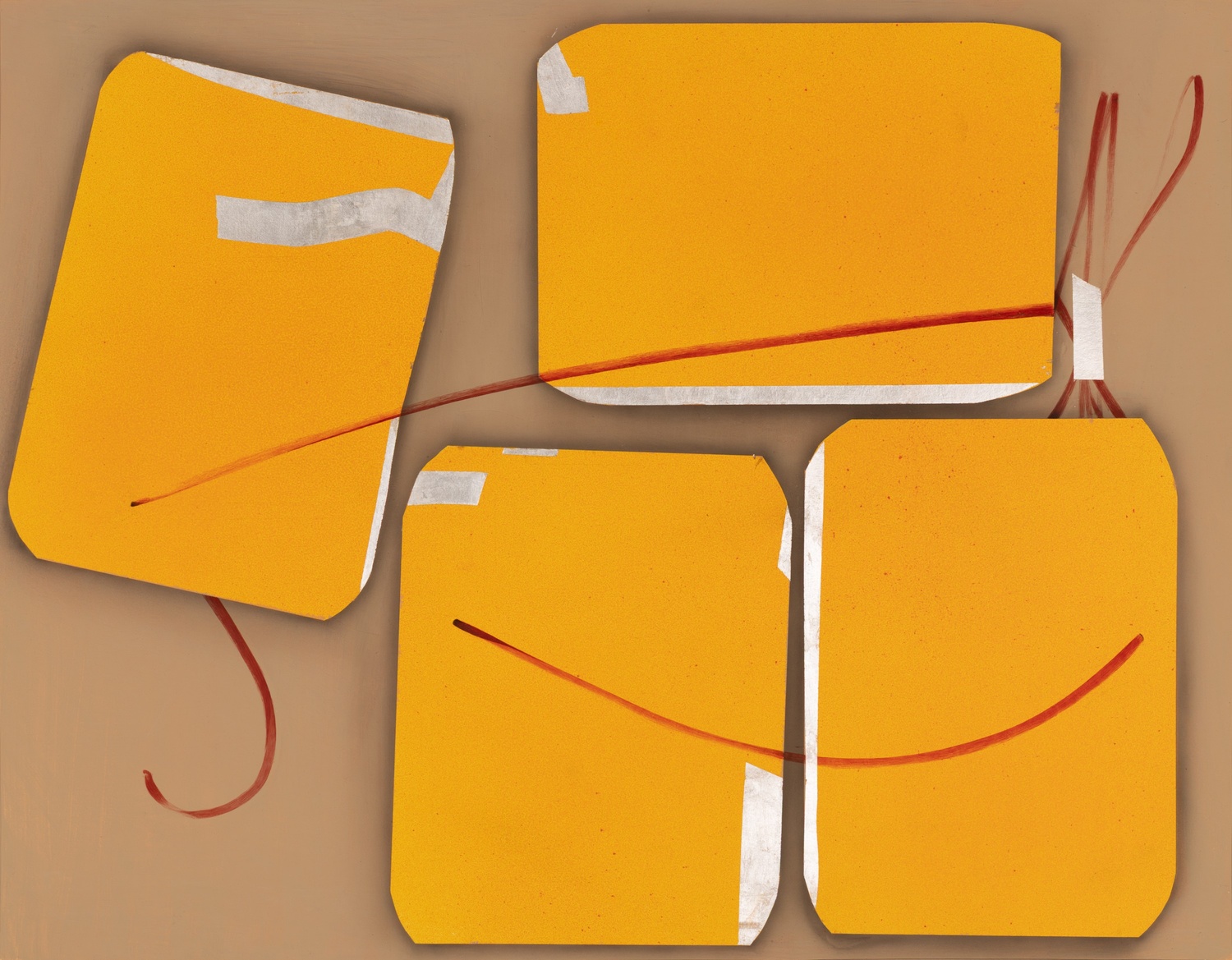
Nusrat translates this practice (so common that often it is not noticed!) into the language of geometry. Her most recent work is a combination of grids and patterns that suggest metal grills, construction net, and the design of (internationally recognized) municipal barriers with their repeated bands of yellow and black. In these, the traces to Seema Nusrat’s earlier, Karachi-connected artworks, are frayed because the new pieces have a dominating element of abstraction. Abstraction in art, that originated in the beginning of the twentieth century, with its conceptual, spiritual and subliminal overtones, also switched our gaze, attention, and interest from reality (in all senses of the term) to pure pictorial matters. Towards a tendency of dealing, decoding – and anticipating social, psychological, political, ideological issues in the language of forms. In the mid of last century a number of European (mainly the French) theorists argued that meaning lies within language, not outside of it. Language by itself is more potent and significant than what is intended by the writer; to the extent that Roland Barthes replaced the term author with the word scribe. (Arguably one reason for this shift in thought could lie in witnessing WWII, an experience that crumbled the faith of human will, decisions, acts).
Human beings also appear in Seema Nusrat’s latest works. But transformed (disguised?) as packages. These elongated and hard-edged masses (manufactured in metal) are grouped like a family, with their heads and lanky bodies concealed in angular and simplified armors, while resembling the Cubist imagery. But more than mere formal excursions, Nusrat’s sculptures remind of Rene Magritte’s canvas, Perspective II, Manet’s Balcony from 1950 (an appropriation of Edouard Manet’s painting The Balcony from 1868-1869). The Belgian Surrealist changed three human figures of the French Impressionist painter’s work, into three wooden (coffin like) riveted boxes, arranged in the same order the earlier master composed his models.
Magritte’s work somehow furthers the reading of disappeared faith in humans; and encountering fatalities consciously caused by Sapiens. Similarly Seema Nusrat’s large scale humanoid sculptures clad in metal sheets, document as well as comment on the fear, risk, danger a human faces from another. Death can come by fate, beasts, medical problems, or natural disasters, but it is more – and most unbearable when it arrives in the shape of a dagger, bullet, bomb, drone, or an exploding pager and other comfy gadgets.