The opening pages of Mustansar Hussain Tarar’s novel “Bahao” (Flow) describe the last flight of a bird that is desperately clinging for life as it searches for water. Teetering between life and death, delirium and dream, pain- induced haze and half-formed memory, it still attempts to map out the contours of the parched landscape below. The remnants of a dying civilization are visible even from above. The land is parched. Even at the precipice of death when doom is imminent, it is searching for the life blood of the Indus Valley civilization: water.
In this opening scene which spans over several pages Tarar establishes a link between the lived environment and its relationship with nature. In a nutshell, he is describing “the geography of extinction.” (Liu 2023) The land is dying as are its inhabitants both human and non-human. What is happening to them on the cusp of death? The character of the bird in these pages is depicted as an ill omen of the future, the metaphor that exposes the violent disintegration of eco systems. The description of burning flesh and feathers, the atrophy of muscle and sinew- it is a gut wrenchingly slow narration of death as the bird sapped of energy begins to waste away in the scorching heat while midair. Witnessing the death of the corporeal- the atrophying of mere flesh to be precise- of bodily presence transforming into an unrecognizable spectre of its former self- skeletal remains and something that is no longer charismatic and graceful serves as a reminder that “coevolution can switch over into coextinction, co-becoming into entangled patterns of dying-with.” (Liu 2023)
Interestingly, even as the bird finally lands near water, amidst a sea of birds and in sight of Paroshni the main female character there is an odd comfort in the fact that it dies in the midst of its own kind, as if that is the greatest saving grace that Nature can offer to a doomed species. The context is important here: a dying body of a bird on its last journey is finally identified with community, inscribed by and sanctified by a web of relations. Its symbiotic relationship with tradition, customs, language and a way of life is established and then simultaneously extinguished as if to emphasize the cruelty of this loss.
The pathos in these scenes is such that it is also a cogent reminder that death is slow and not necessarily noble as one imagines in epics, myths, ballads and battles. Can the flesh-and-muscle beings, hybrids- paused in transit in Aasim Akhtar’s drawings- be positioned in a similar context? That is to say that within “an era of ecocide” (Jones, Rigby, and Williams 2020) they emerge almost as harbingers of environmental and sociological doom, signaling that “The End is Nigh”, so to speak where both “non-modern” culture and identity and biodiversity are going to disappear along similar lines. (Jones, Rigby, and Williams 2020) Could there be some grain of truth in this, some fragment that is also evident in this body of artworks?
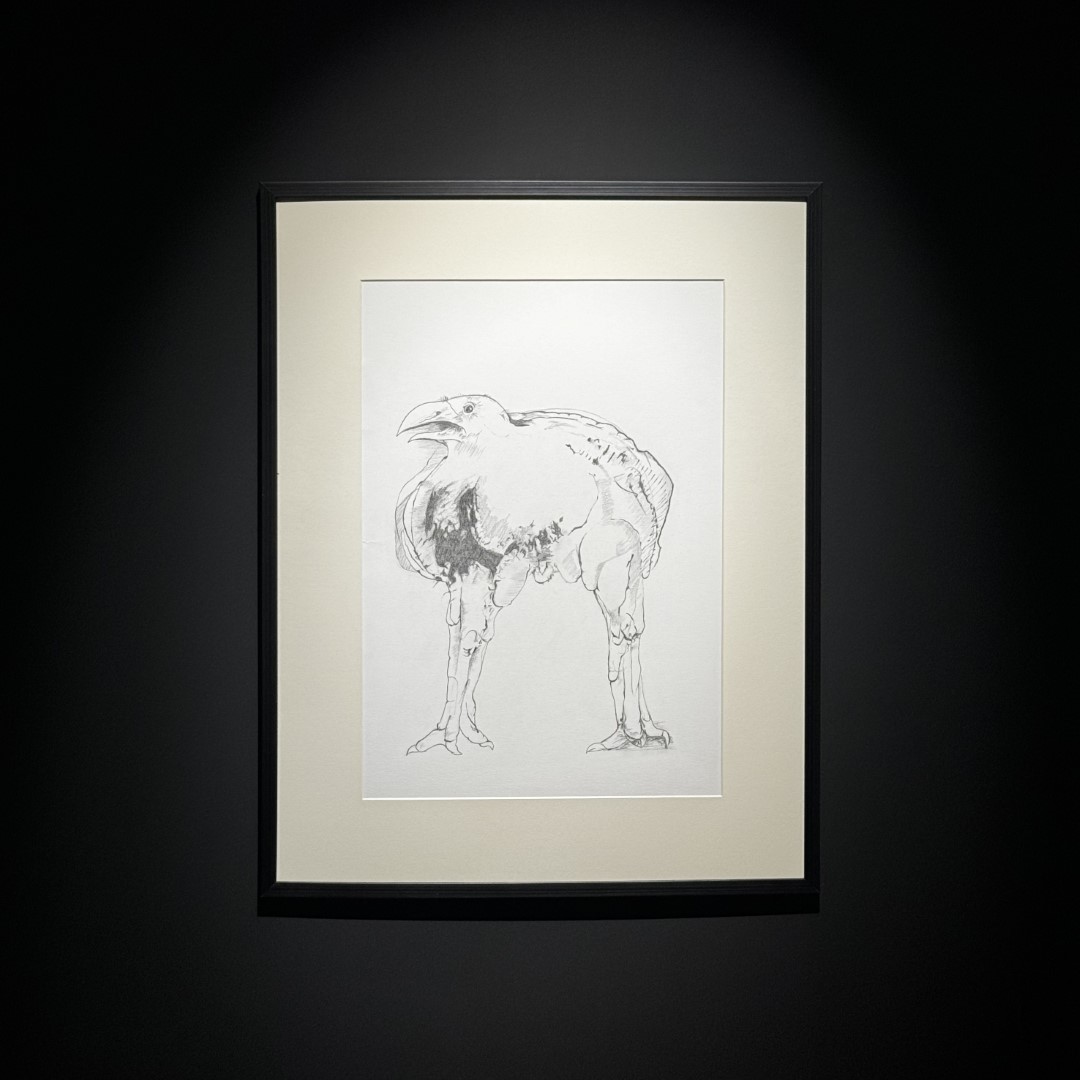
Some of Akhtar’s drawings feature anthropomorphic representations of beings that have the body of a human and the head of a crow. In 17th century Europe it was physicians who may have resembled such forms; they wore a mask with a bird-like beak when tending to plague victims. It was believed that the plague was spread through poisoned air and the beaks of these doctors contained many protective herbs that would ward off disease and pestilence. (Blakemore, 2020) For Akhtar the inspiration for this distinct representation of the figure and its production is embedded in a completely different non-Western social and cultural milieu. His musings about crows, their regional aphorisms, connotations in song lyrics and even literature encompass a holistic, compassionate world view and heritage that is indigenous to this land but is now sadly subject to neglect, erasure and loss. Yet to fully recognize this loss what can one grieve if one is unfamiliar with the site of loss to begin with? i.e loss is not experienced in a vacuum; it is relational. (Liu 2023) If these cultures and narrations have already ceased to exist as the topography, flora and fauna that has sustained them is subject to replacement by concrete jungles, industrial waste and gated communities then how long can collective memory endure the onslaught? The psychoanalytical loss and pathos that persuades viewers to enter a work of art, much like the opening scenes of the novel “Bahao”, is contingent upon the weight of our collective memory. Anecdotes, memories, myths, dreams, stories, however fragmented, should endure and outlive physical space and time. (Liu 2023) Yet Akhtar’s figures are besieged by a peculiar kind of experience of loss that is a crisis of post modernity, one that simply does not recognize this predicament nor that something unjust is happening to our environment, our “non-modern” cultures and our communities. When we conversed regarding his work, it was the figure of the animal that formed the conduit between understanding how the inner and outer world of Aasim Akhtar was informed by their presence in his life and even his mother’s life. This loss of the respect for nature, a disregard for the sensory and empirical that was once enmeshed with culture is now incommensurate with the scale of the crisis.
In the world of commodity culture, advertising and social media, images of live animals are ubiquitous. They either operate with captions, memes, emojis and sound effects or as images without referents replicated across networks and spaces both real and hyperreal. Even as dead animals they are meant to be consumed once they travel through a network of slaughterhouses and laboratories. (Reinert 2012) As cruel as it sounds, the violence inflicted on cultures through the manipulation, repetition and replication of screen images never even allows even animals to fully die, to become myths or part of collective memory or fall into the category of the “endangered.” Shorn of context and referents they emerge in the present as a sort of “undead” figure, the manifestation of entangled absences, a product of cultural amnesia, half formed so that they turn away from civilization and also fossilize it by relegating it to an antiquated, irrelevant past.
For instance, although Donna Haraway’s text “Cyborg Theory” uses Cyborgs as a metaphor that is a radical rhetorical response to Second Wave feminism; I would argue that tangentially her Cyborg may share some intersections with Akhtar’s distinct figurative representations. Both Haraway’s cyborgs and Akhtar’s crow-like beings are complete in themselves, they are beyond gender and certainly not a Frankenstein-like aberration.
Much like the bird and Paroshni featured in Tarar’s novel, Akhtar’s representations are also of beings perched on the edge of life and death; they are manifestations of an ongoing crisis of their own time. In response they commit a renegade act. Under the power of Akhtar’s consummate skill, they choose to radically, silently, stubbornly exist in situ to signify and protest their absence and denial in our lives, to morph and age most unromantically and unapologetically with a flagrant disregard for propriety or heroism. Akhtar’s hybrid beings express raw, unadulterated, primal emotion. They voluntarily choose to “expose” the process of aging “crudely” and rudely without the conventional and almost glib notions of grace and solemnity attached to them. It is in this crucible between past and present, ecology and the Anthropocene, dead and “undead” that the context and tenor of Aasim Akhtar’s works remains extant, percolates and filters through our modern-day consciousness.
Much like the bird and Paroshni featured in Tarar’s novel, Akhtar’s representations are also of beings perched on the edge of life and death; they are manifestations of an ongoing crisis of their own time. In response they commit a renegade act. Under the power of Akhtar’s consummate skill, they choose to radically, silently, stubbornly exist in situ to signify and protest their absence and denial in our lives, to morph and age most unromantically and unapologetically with a flagrant disregard for propriety or heroism. Akhtar’s hybrid beings express raw, unadulterated, primal emotion. They voluntarily choose to “expose” the process of aging “crudely” and rudely without the conventional and almost glib notions of grace and solemnity attached to them. It is in this crucible between past and present, ecology and the Anthropocene, dead and “undead” that the context and tenor of Aasim Akhtar’s works remains extant, percolates and filters through our modern-day consciousness.
Associations with the arcane or cabbalistic cannot be drawn either; instead one is forced to wonder if it is just the fascination with sagging flesh or the proficiency with which the stodginess is conveyed that excites Akhtar’s imagination. Too mature to be caricatures and too chilling to be vulgar, Akhtar’s characters are their own complete beings. The postures of these hybrid figures carry an unhurried confidence; some are half squatting but poised to look forward, others squawk with abandon with their legs open. The viewer may see body hair, bodily imperfections, voluptuous rolls of flesh contrasted by scrawny legs. For those who follow decorum and abide by a conventional notion decency, the perversity is complete and feels like a deliberate assault on the senses.
In the second category of drawings the figures resemble large beings with outstretched wings spread out as if crucified, like human scarecrows. Tossed around and weary, with their feathers disheveled they appear half-dead and resigned to their fate. Some of Akhtar’s drawings are more expressive and violent. Gesture and line is used aggressively to provide a sort of evidence of physical violence; Akhtar’s bird-like beings appear to suggest flaying or gutting with the innards being removed. The emptiness is brutalizing and the style contrasts with more effulgent representations of flesh. The last category consists of anatomical and biological studies of portions of bird forms. The materiality of the medium is helpful in enhancing this effect; drawings teeter between diagrammatic representations and an abstraction that negotiates its own borders. The ambient effect is that of a barrenness that is magnified or is evolving.
Absence is a necessity for registering presence. Presence is usually meaningful implying a completeness that is cathartic, sublime. Instead the visibility of decay, aging and fragmentation represents a disquieting continuum of degradation. In this body of work it elicits both revulsion and acceptance of dissonances that signal a much larger crisis in society.