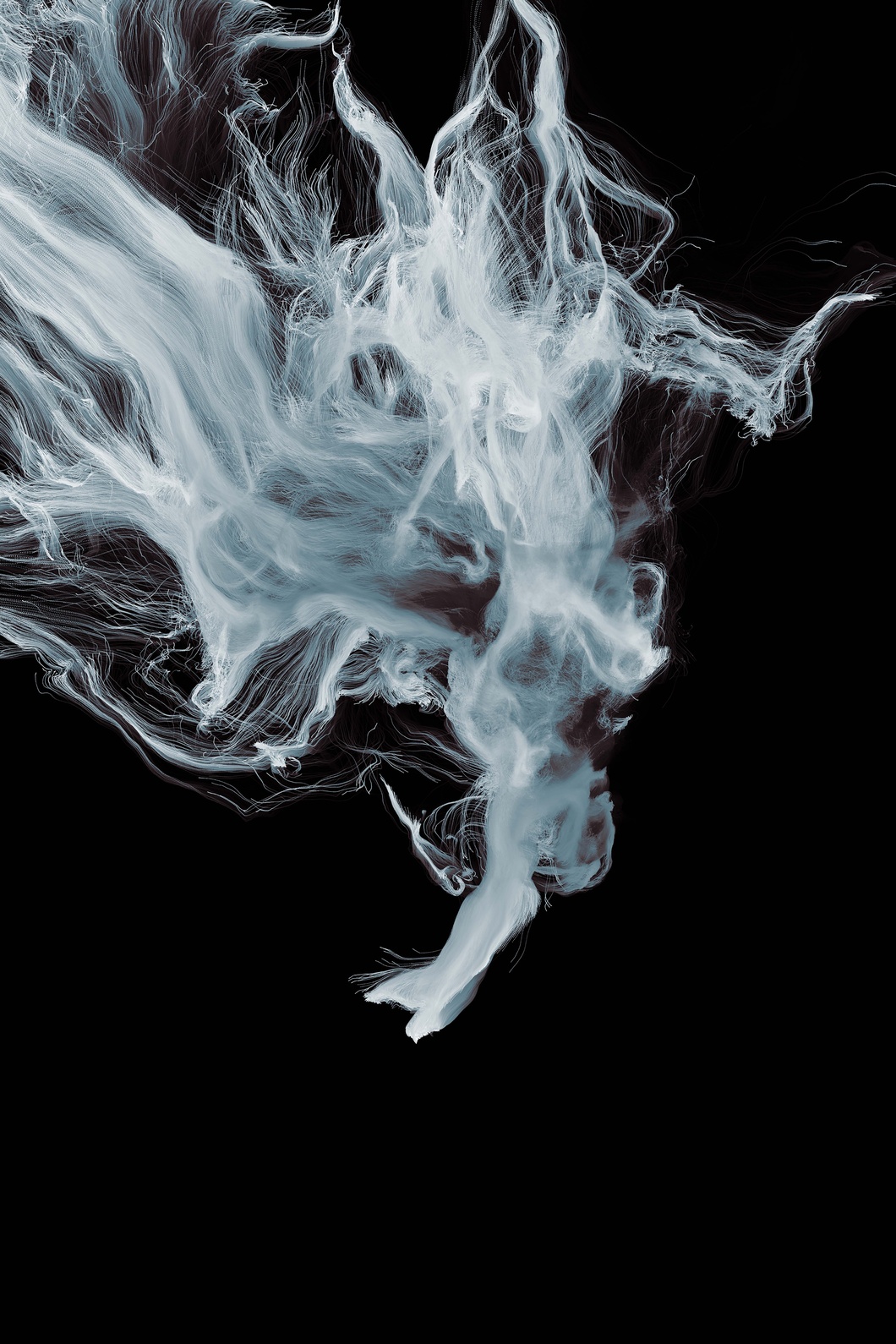
Faisal Anwar’s CommonSky invites us to explore and imagine the realities and possibilities of a world that is coming into being. The exhibition’s works narrate a story of what is changing and asks us to think deeply about what may materialize. Lines That No Longer Hold, a series of layered digital works in the forms of UV inkjet prints, explores the changing patterns of bird migrations, particularly Purple Martins, owing to increasingly recurrent heatwaves. It raises questions about the increasing fragility of non-human ecologies in the Anthropocene, the age in which humans are having substantial impacts on the planet. Astrolabe 2.0.01 is Anwar’s re-invention of the astrolabe, a two dimensional, hand-held, astronomical instrument constituting a star map and earthly coordinates historically developed by the Greeks, Christians, Muslims, and Jews. By furnishing it with a twenty-first-century digital interface that enables it to read streams of weather data (temperature, carbon, soil, and humidity) from Manaus (Brazil), Chicago (USA), and Lahore (Pakistan), Anwar enables the navigational instrument to show the climatic conditions that these three places may face over the next 100 years. Anwar’s astrolabe is presented in a series of brass plate engravings as well as a navigational interface, that labours to catalyse the creative manifestations in the Azimuth of Time, a real time, immersive, living, and breathing digital forest that enables us to travel from the known past into a possible future.
The works in CommonSky bridge the divide between art and science as well as the organic and the digital while prompting new conversations about the shared future of our planet. Nature and climate have regularly featured in Anwar’s art practice. In Char Bagh: A Sensory Garden (2016), for example, Anwar explored the increasing blurred boundaries between nature and technology by creating a site specific abstract visualization of a char bagh, the Persian/Urdu name associated with the proto-typical Indo Persian Islamic four-part paradise garden, the most iconic of which is the Shalimar Garden in Lahore commissioned in 1637 by the Mughal emperor Shah Jahan (d. 1666). Projected on the façade of the Aga Khan Museum Toronto, Anwar’s Char Bagh was made up of multi-scalar grids of colour-coded square tiles that alluded to a garden’s pathways and greenery. The tiles were produced using data streams generated by audience members’ texts and images posted to social media platforms including Twitter, Instagram, and Flickr. This and other of Anwar’s works aim to draw people into dialogues with each other through digital platforms. In Oddspaces (2008–2015), Anwar experimented with networked, live multi-channel videos between different locations and time zones (Pakistan, India, and Bangladesh), and used SMS messages as a communication tool between them. For Anwar, such experiential and aesthetic experiences enabled people to interact and communicate across geographical, social, and political divides, challenge each other’s preconceptions and perceptions, ask questions, and build new communities.
A residency at Labverde in Manaus (Brazil) in 2019 provided Anwar the opportunity to immerse himself deeply in ecological issues with scientists and artists in the Amazon. This profound experience asked Anwar to surrender to the rainforest and its diverse life-forms and realise that all creatures share a common sky. Thereafter, Anwar set himself the challenge to communicate the data collected by scientists about the Amazon’s changing ecology to a wider public using art, design, technology, and emerging technologies such as artificial intelligence. A self described hybrid artist, Anwar uses numerical data sets and new technologies as parts of his toolkit. In his artistic practice, these tools are akin to paints and brushes. He defines digital/new media as everything that has these digital inputs, which you can pull in physical computing and manipulate. However, for Anwar these tools are not an end in themselves but allow us to see things that have not been fully perceptible. Thus, CommonSky, while challenging in its forecasting of a potentially less than desirable future for our planet and all its lifeforms, is also captivating and arresting. The works confront the reality and uncertainty of climate change and attune us to its imperceptible yet certain signs. In so doing, the exhibition’s works portrays the fragility, beauty and complexity of the existential world. They ask us to bear witness to our connectivity across all forms of matter through time and spaces, submit to the majesty of creation, and reflect on the imperative of our custodianship.
_____________________________________________________________________________________________________________________________
Zulfikar Hirji (DPhil, Oxford) is anthropologist and historian. His work examines the diversity and plurality of Muslim expressions in a range of historical and contemporary contexts. He has published a range of books and articles based on archival and field-based research in South Asia, the Arabian Peninsula, East Africa, Europe, and North America. His curated exhibitions including Memories of Stone: Landscapes of Prayer, Death, and Commemoration in Bosnia and Herzegovina and Enlightenment in a Digital Age: The Contemporary Art of Ali Kazimi, Faisal Anwar, Jamelie Hassan, and Fareena Chanda.