“A Portrait of the Artist as a Young Man” by James Joyce is famous for the unique narration of its events. The first chapter in particular is interesting; as readers we are inside the world of Stephen Dedalus, trapped with him in his wondrous understanding of tactile and sensory experiences but with events unfolding around him that are beyond his comprehension. There are moments when the narration by Joyce feels too literal, too simple and perhaps that is why we as readers are so taken in by his writing. His vignette-like descriptions of the world as seen through the eyes of Daedalus do not delve into complexities. Like a child, he sometimes introduces us to a reading of his surroundings that is so literal in its unassuming innocence that we are compelled to reflect simultaneously, both on its appearance and its simplicity. As we are sucked into the mind of Daedalus, there are snippets of Joyce’s stream of consciousness writing that finally leave us teetering between these two tangents: we as readers are left asking what kind of social, cultural or psychic complexities bubble beneath the surface of the worlds that Joyce paints for us.
The works featured in this exhibition also “stray” into this territory. The child-like simplicity of expression, painterly skill belies the intent of the artists themselves. It is interesting how the word “stray” with its various implicit meanings- the title for this exhibition- is so fluid, natural and languid in its acceptance of various states of being, much like the world of Daedalus. It can be very literal and nothing more. It can be this and that. Yet it could also be that and more. The word “stray” be used both a noun and a verb. To stray could imply deviancy but the intent could be mee curiosity. The “stray” in the world of nouns could be a hidden card. He/She may one day emerge as a maverick, trailblazer or embody pure evil. Perhaps he might choose to remain a vagabond but figuratively.
“Stray” features the works of three contemporary Pakistani artists Ayaz Jokhio, Aamir Habib and Rabeya Jalil who embody a fragment of this state of being. They attempt to follow the path less taken with their incendiary approaches to art making, compelling viewers to follow suit and expect the unexpected.
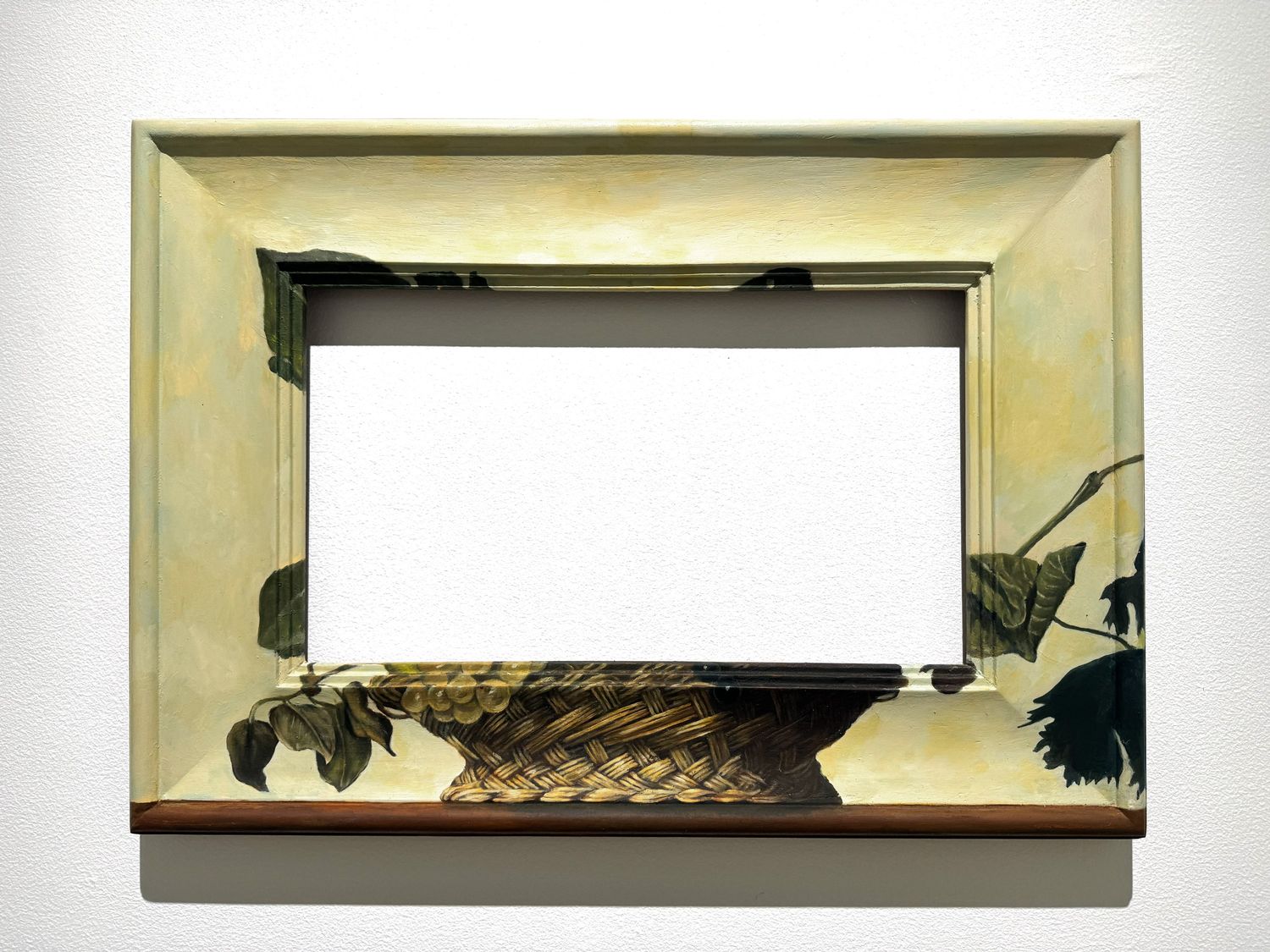
Ayaz Jokhio appropriates and meticulously repaints iconic paintings from European art history but as always there is a subversive twist that is characteristic of his signature style: his figures appear to have strayed out of the space reserved for the canvas. Olympia and Caravaggio’s still lifes appear fragmented, almost distorted as they are painted onto the polished beveling of the frames. Nevertheless, the table are turned and a certain kind of art historical subject matter is relegated to the margins, so to speak. The empty space once reserved for the canvas and its Eurocentric subject matter poses questions about historical omissions, representation and the various histories of exclusion that are written out of Art Historical discourse.
Aamir Habib’s reliefs featuring “floating” heads of bearded men do not come from a tradition or style but they exude an energy and dynamism that surpasses these trivial aesthetic categories. Their intensity and sense of purpose reflects in the furrowed brows of their expressions and the sweeping swish of their beards. Is it an inner psychic state or a mere physical manifestation of their wandering mind? That is up to the discerning viewer to decide.
Rabeya Jalil’s delicious delight in painting with a faux-Neolithic flourish is unfettered by the polite gatekeeping of what constitutes as prosaic, mainstream gallery art. Her wonky figures with their yawning, gaping physiognomies veer towards the comical rather than grotesque, sometimes refracting into a tactile experience that is both jarring and familiar. We sense the noise visually, in its most undiluted and raw form. Her other works reimagine surfaces as a precarious assemblage of racing, hectic, brushstrokes, punctuated by forms and body parts that hang or protrude precariously from a jumble of visual noise.
All three artists are connected by their willingness to ruminate on the place of hierarchy even within contemporary art; they assess shifting terrains of meaning within this landscape.