“I think of my life’s work as a celebration of all of nature, an orchestra that plays not the sounds of one musician, the music of one species, but rather an expression of all of nature’s songs.” – Gregory Colbert
This Land is your Land, curated by Imran Qureshi, takes its title from a poem by Woody Guthrie signifying the message that we are all (including wildlife) equally entitled to the rights of this land that we stand on. The exhibition features work by Elisa Caldana and Kamran Saleem that addresses a shared desire for all species to participate in a universal conversation, seeing nature as the greatest storyteller of all.
Elisa Caldana, born in 1986, is an Italian artist working primarily with sculpture, performance, film and writing. She graduated from Städelschule Frankfurt, and the University of Venice, and has shown internationally at The Hague, Amsterdam, Rome, Bologna, Turin, London, Mexico City, Tokyo and Frankfurt-am-Main. She is an alumna of Jan van Eyck Academie, Maastricht, and recipient of the Mondrian Fund.
The Falcon of Karachi, comprising a video projection and a soundscape, was produced with Luisa Puterman (composer) and Zeerak Ahmed (vocalist) in collaboration with Vasl Artists’ Association in Karachi – where she had been an artist-in-residence (2024).
The video piece ‘explores the identity of Laggar Falcon’, taken captive in Malir, tied to a charpoy. The audio piece originated ‘as an attempt at imagining a sound identity for the bird…without words.’
Falconry is one of the oldest known human activities, dating back millennia to before the existence of written history. Whether it is practiced for survival, for sport, or for a way of honoring the past, it continues to evolve unabated. Over centuries, this practice spread outward from the Middle East along the Silk Route, and evolved from sustenance hunting into royal recreation – the ‘sport of kings.’
Falcons are threatened by a dangerous combination of habitat loss, increasing scarcity of prey, and other factors from changing land use and deforestation to climate change. One has to connect with and understand the environment to understand the natural capabilities of the falcon.
A conversation with an animal begins by watching gestures and reading facial cues. It is a non-verbal conversation. You do not think a falcon; you try to feel it. Such is the invocation in Elisa Caldana’s video art. She creates a climate of trust that opens the way for spontaneous interaction with the captive falcon. You cannot chart its course, dictate its wanderings, direct its gestures or choreograph its flight.
Our perception of nature is often human-centric; Caldana is looking at the world through the eye of the falcon when the falcon, blindfolded in a leather hood, cannot see. Some are illegally taken or captured from the wild each year for use in falconry, in which people train the raptors to help them hunt or as a decoy. They are a vulnerable species, facing a challenge it cannot flee. The sport has doomed it to exploitation.
The soundpiece, like a whale song, is the last wild voice calling to the consciousness of terminally civilized humanity, our last contact with nature before we submerge forever in our own manufacture and lose forever the final fragments of our wild selves.
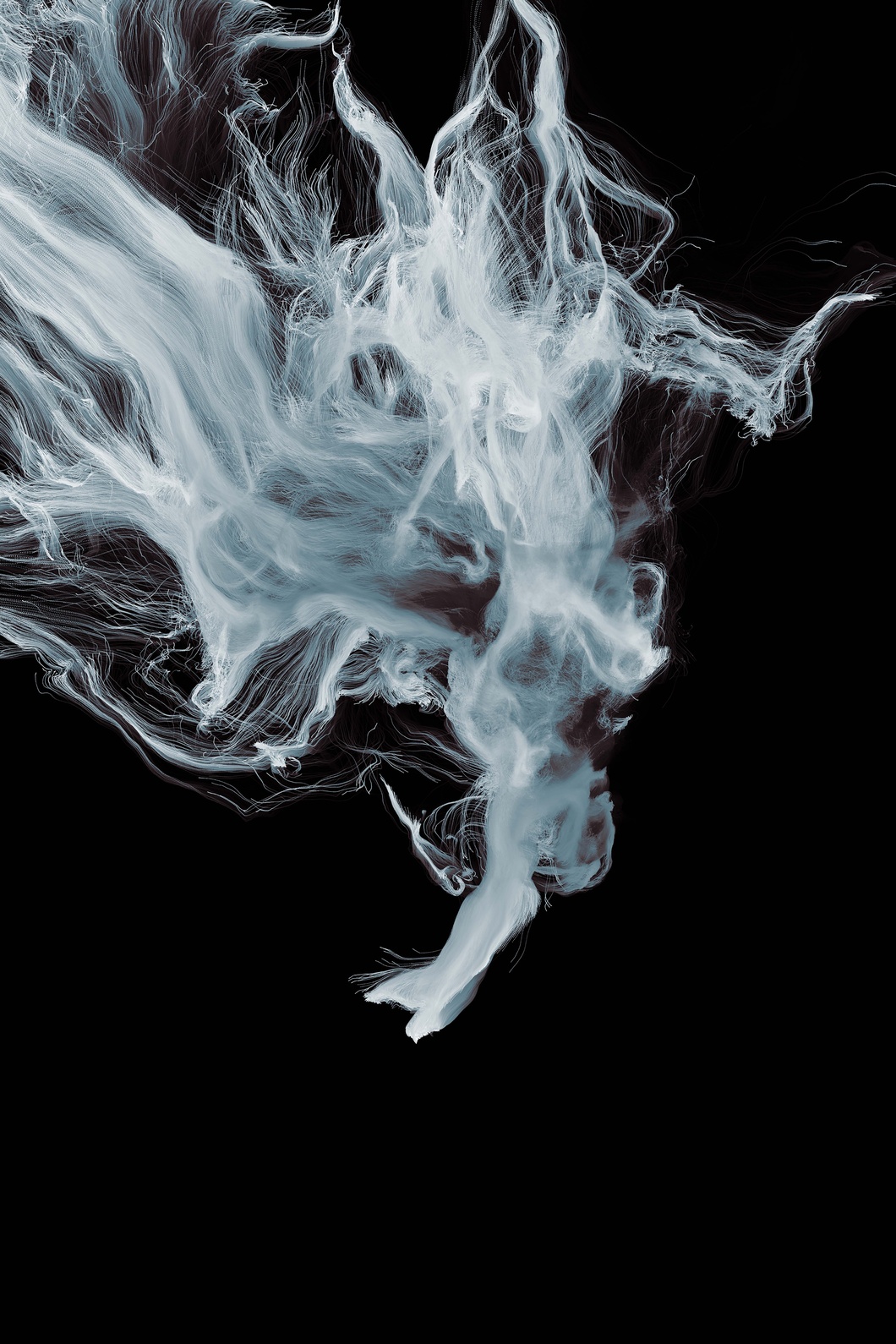
Kamran Saleem is a wildlife filmmaker. His documentary Deosai – The Last Sanctuary won the prize for Protection of Nature at the Ménigoute Film Festival in France, and his books, including Birds of Sialkot and Land of Rhyming Cliffs are much celebrated. The series of images presented in the show focus on a herd of deer in the wild threatened with extinction, forced displacement, exile and emigration. Proprietorship and possession of land by human beings has led to their dwindling population and migration.
The power of Saleem’s images comes less from their formal beauty than from the way they envelop the viewer in their mood. It is the role of artists in all creative disciplines to try to inspire a transformation; to offer a non-hierarchical vision of the natural world, one that celebrates the whole of nature’s orchestra. Just at the moment we are burning down what remains of nature’s living library. Saleem is creating an intangible library of the wonder of the world of deer that reminds us of what is being lost.
The Aborigines were probably exploring the same enchantment when they painted animals – they were not merely interested in painting their contours but focused equally on the animal’s interior dream life.
What does a flock of deer look like in its own domain? Saleem’s photos provide an unprecedented glimpse of deer in their natural habitat. The images have an intensity and awareness that reminds one that wild creatures have a vastly different perspective than humans. These images return us to the sanity of our undeniable, unavoidable, inextricable connection to nature. And they do it with beauty, grace, lightness-of-being, strength.