Looking at the new drawings of Jamil Baloch, of stones rendered in graphite on paper, I started to see stones everywhere in his studio, in the surroundings. In small sculptures (shrouded women clustered together; and the two mountain ranges – produced with different materials), in unidentifiable terra-cotta forms, and even in certain sections of human figures drawn on paper which convincingly resemble grainy surfaces of unhewn stones. In that sense the choice of paper, especially the textured Arches to portray human anatomy adds another dimension to the artist’s aesthetics.
Jamil Baloch, has created works in multiple mediums and techniques, i.e., drawing, painting, printmaking, sculpture, video, (also a performance piece in 2003 at the 1st Vasl International Artists Residency, Gadani, Karachi), but what emerges the most arresting element in all of these expressions and experiments is the artist’s connection with material, or/and his obsession with physicality. In that proximity he is not alone, because the majority of image makers often rely on their hands compared to their eyes to know, explore, and fabricate the world. Take the example of painting, the so-called two-dimensional object, it too evokes a feeling of tactility, either through thin layers, uneven textures, or with thick impasto. So much so that some surfaces are not painted, but are built with semi liquid stuff.
The sensation of a surface and the touch of a tool is not the particular experience of a visual artist. In a conversation with Hans Ulrich Obrist, the Italian philosopher Umberto Eco regrets the increasing fashion of digital devices as the only means of writing in place of traditional pen and paper. He reflects “that the art of writing teaches us to control our hand-eye coordination. It makes us compose a sentence in our head before we write it. The resistance of pen and paper slows us down and makes us think”.
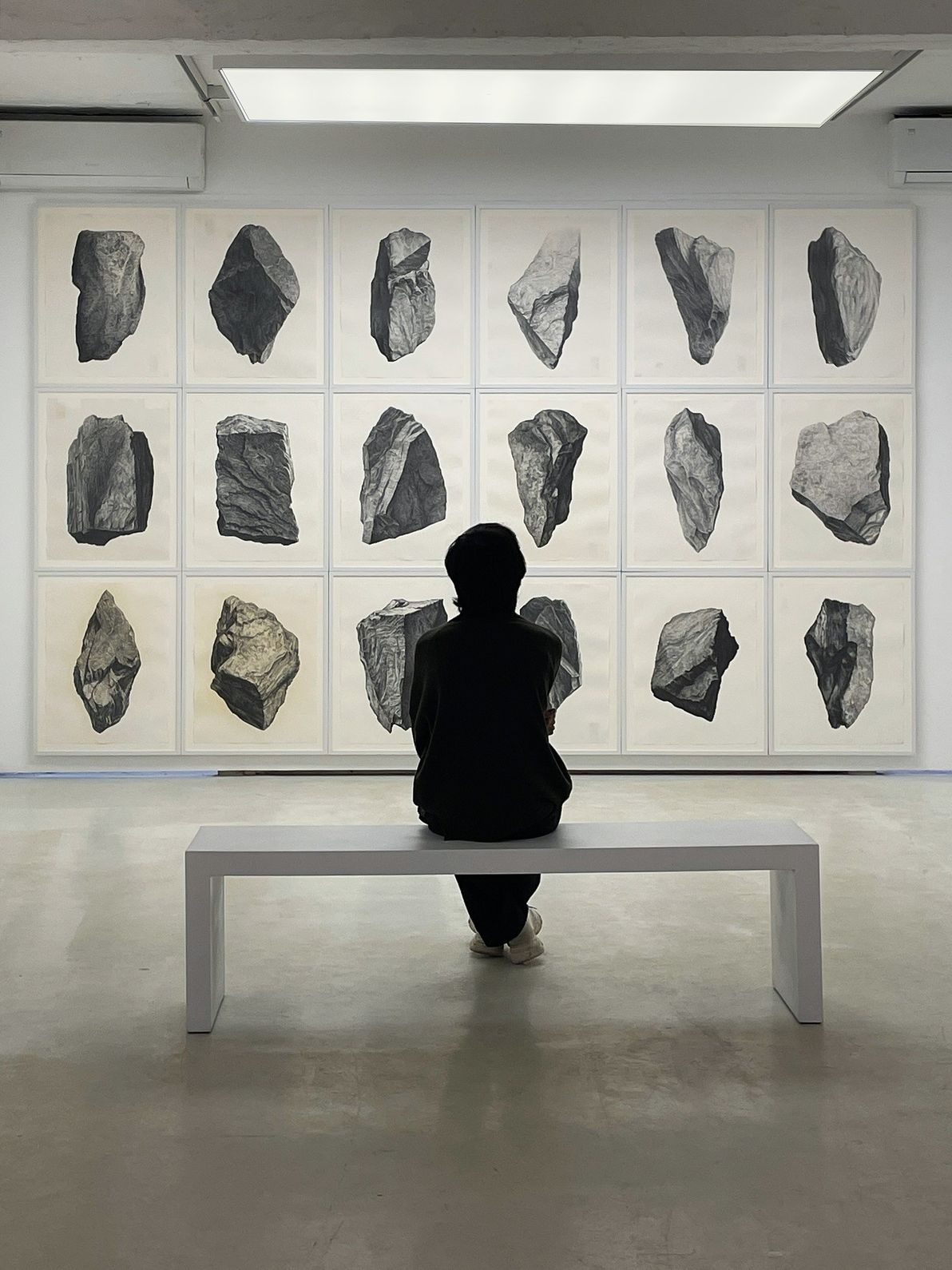
Baloch, exploits this relation, or tension between the tool and the surface, and the shift that takes place due to it, in his new works on paper. Executed with graphite pencils, every image entails a prominently rough texture of stone. Seen as a series, each of these drawings looks like an individual portrait of a stone. Separate and specific from the general categorization of the substance. One may associate them with human faces as every image depicts an unmatching set of cuts, creases, groves, ridges. Hence unmistakeable identities. Looking at Baloch’s drawings, one may begin noticing the importance entangled in things, which lie ordinary, mundane, neglected, and abundant.
Portraits, because Jamil Baloch collected his references/models from different sites – including his hometown in Balochistan, and Lahore, his city of work. Originally of varying scales, Baloch brought them down to a singular measurement when capturing them on sheets of white colour. This process could be compared to the passport office, where each person’s face is recorded in the regular posture, against the same background, and of identical measurement. But in spite of these efforts of standardisation, all people have diverse features, characters, personalities; like in every language there exist multiple options for stone; in English these could be pebble, gravel, rock, boulder, but as observed by Jacques Derrida, in a singular language, no one word for an expression can be a replacement of another one, even for a similar type.
What a language is but a system of signs and so is the language of picture making. In that light, if one analyses the visuals created by Jamil Baloch, these are more than the apparent pictures of stones. They signify other meanings. Just the fact that all (except one) drawings contain stones in vertical formats; much like a standing human being. Along with details of observations of mass – confirming the artist’s great facility of replicating reality –these stones reveal the presence of light through sharp, stark, or subdued shadows. Some, through their conical top allude to mountains – in most cases the origin and reservoir of this material; but in contrast to a natural form, these pieces are cut, and extracted from their initial source.
Stones, repeated in Baloch’s work, offer something more than merely depicting his fascination and familiarity with the material. Being trained as a sculptor, he produced works of all scales and in every substance – ranging from monumental human figures to small heads, and from fiberglass sculptures to plaster casts and terracotta pieces. His stylized paintings are often about manipulating the material, as was observed in the works produced during his student years; those large mixed media on boards. The current drawings are also a form of paying homage to black graphite of pencil, and to the whiteness of paper.
Though the two are contrasting colours, in Baloch’s art they share a single quality; roughness. A coarseness that alludes to another, perhaps the real content of the work. Jamil Baloch not only belongs to Balochistan but is aware of its literary legacy, cultural geography, and political history. Elements which appear in his art in varying formations. To him, these recent works do not depict stone, but Sang – understandably because the Urdu and Persian term for stone not only translates the English expression, it connotes a segment of hardness too. In a conversation, Jamil Baloch recalls the iconic Baloch leader Nawab Khair Bakhsh Marri, and his comrades, who believed in the strength of struggle, resistance, and fight, instead of compromise.
Hence the past of the province is stained with blood, military operations, and central rule since the 1970s. Today the situation may have changed, yet are still spots of dissent and news of disappearances. In that background Jamil Baloch’s stones are not just pieces of rock, or building material, or minerals arranged on the central table of a cosy house (or framed artworks on a wall), these are immortal substances that have witnessed the passage of time, the flow of life, the fading away of injustice, the traces of victims; and will remain there – silent but present. These steadfast forms convey a continuous narrative of confrontational, clashing, and challenging scenarios.
As the present body of work in its abstract sense could be embodied with a political meaning; it also reminds Baloch’s entry in the 1st Karachi Biennale, 2017. Composed of non representational there was a set of white forms on the ground, which on further examination, emerged as body-bags trampled by armoured vehicles. Similar to that strong visual, the current drawings of stones are also buried with concealed content.